
CODEX 1.1
Operatives, welcome to Operation LAPIS. Please make your selection from the above CODEX menu options for Episode 1.1
How to use the CODEX:
The KEY-TEXT is a selected passage that should assist operatives in the immersion. These KEY-TEXTS often provide additional, and relevant, information about the current situation. The KEY-TEXT also provides an opportunity to gain additional practice reading Latin.
The GRAMMATICA gives explanations on how the Latin works in comparison to English. When beginning a new episode, each operative should first visit the GRAMMATICA section in order to understand the new concepts which are introduced.
The VERBA toolset gives glosses (meanings) for the Latin you encounter in your TSTT-insertions. When encountering new or unfamiliar words in the TSTT-insertions, all operatives should first consult the VERBA section before utilizing additional resources.
The CULTURALIA section provides relevant cultural background information. After operatives have read the new TSTT-insertion, they should first consult the important information provided in the CULTURALIA before beginning a discussion with his or her teammates.
The ATTUNEMENT option provides access to the attunement challenges for the current episode. These challenges are designed to help you, as an operative, gain additional skills in Latin and in Roman culture.
KEY-TEXT
via prope Pompēiōs
tua persōna est in viā. via est prope Pompēiōs. Rōma est prope Pompēiōs. Rōma est in Ītaliā. Rōma est urbs māgna in Ītaliā. Ītalia est prope Graeciam. Athēnae sunt in Graeciā. Sparta est in Graeciā. Rōma nōn est in Graeciā. Mōns Vesuvius quoque est prope Pompēiōs. Mōns Vesuvius est volcānus māgnus.
puer est Rōmānus. puer est bonus. nōmen est Tiberius. Marcus quoque est Rōmānus. Marcus est senex malus. puer in Pompēiīs habitat. Marcus quoque in Pompēiīs habitat. Tiberius in arbore latet. arbor est in agrō prope viam. Marcus puerum quaerit. Marcus puerum in arbore nōn videt.
Visual Walkthrough
Informational Text A
Geographia
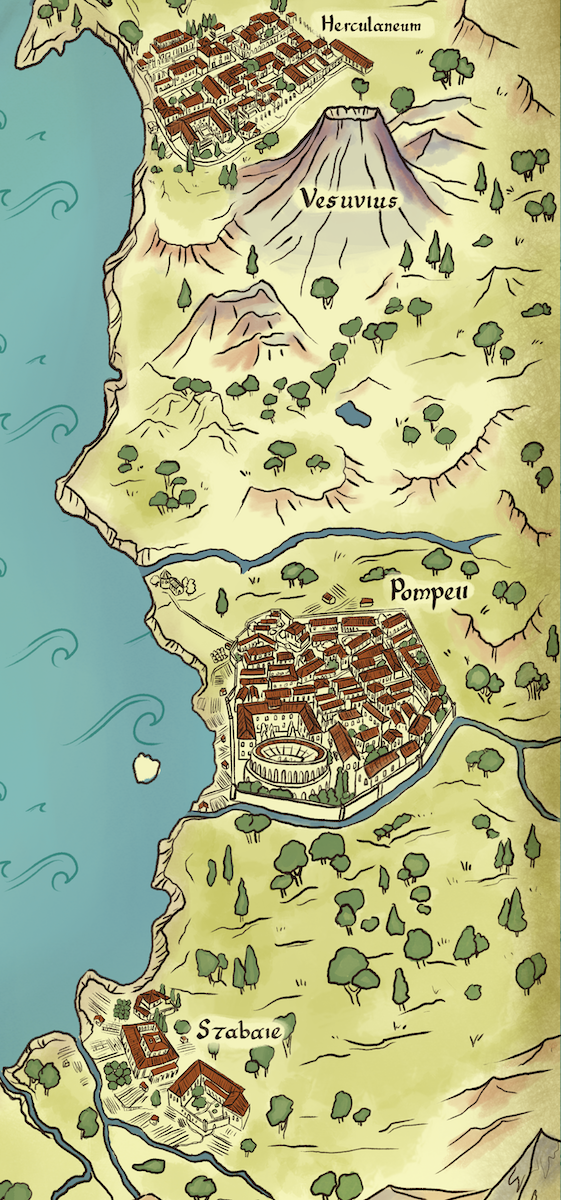
Rōma est urbs māgna in Ītaliā. Ītalia est in Eurōpā. Ītalia est prope Graeciam. Graecia quoque est in Eurōpā. in Graeciā sunt urbēs māgnae: Athēnae et Sparta. Rōma nōn est in Graeciā.
Rōma est in Ītaliā. Rōma quoque est urbs māgna. Ītalia est iūxtā Mare Mediterrāneum.
oppidum nōmine Pompēiī est prope Rōmam. in Ītaliā, prope Pompēiōs, sunt duo alia oppida: Herculāneum et Stabiae.
inter Herculāneum et Stabiās est Mōns Vesuvius. Mōns Vesuvius quoque est prope Pompēiōs. Vesuvius est mōns altus. Mōns Vesuvius est volcānus māgnus!
Mōns Vesuvius et Pompēiī et Stabiae et Herculāneum sunt prope Mare Mediterrāneum.
Vasingtōnium est urbs māgna in Americā. in Americā sunt multae urbēs māgnae: Novum Eborācum, Bostōnia, Philadelphia, et alia.
America est prope Canadam. in Canadā quoque sunt multae urbēs māgnae. America et Canada sunt inter Ōceanum Ātlanticum et Pācificum.
Informational Text B
Tria Nomina
Rōmānī virī tria nōmina habent.

prīmum nōmen est praenōmen. Marcus est ūnum praenōmen. Tiberius est aliud praenōmen. Rōmānī multa praenōmina nōn habent.
alia praenōmina sunt:
| Appius | Gaius | Manius | Sextus |
| Aulus | Gnaeus | Publius | Septimus |
| Decimus | Lucius | Quintus | Titus |
fēminae praenōnima nōn habent.

secundum nōmen est gēns. gēns Rōmāna est familia māxima.
fēminae saepe nōmen patris habent. Marcus Tullius Cicero fīliam habet. eī nōmen est Tullia.

tertium nōmen est cognōmen. cognōmen indicat familiam minorem.
Marcus Tullius cognōmen "Cicero" habet. frāter Marcī, Quīntus Tullius, quoque cognōmen "Cicero" habet.
nōnnullae fēminae cognōmina habent.
Marcus Tullius Cicerō ūnam fīliam habet. eī nōmen est Tullia.
Gaius Laelius Sapiēns duās fīliās habet. nōmina sunt Laelia Maior et Laelia Minor.
Marcus Livius Drūsus ūnam fīliam habet. eī nōmen est Livia Drūsilla.
GRAMMATICA
Operative, you may have noticed that words in the Latin language change their endings while still referring to the same thing.
For example, when malīgnus described the malus, it ended in -us. But when it described his vōx (his voice), it ended in -a: vōx malīgna. The thing being described changed, so the ending changed. You may wish to look back at the TSTT prompt to see this for yourself.
Something similar happened with arbor. When it stood next to est, it was simply arbor. But after the little word in, it picked up an extra -e: in arbore. Same tree, slightly different shape. Look back at the prompt and watch it happen.
In order to reach your objectives in Operation LAPIS, you will need to grow as a reader by learning to recognize these differences in Latin endings, and what they tell you. As the operation continues, the GRAMMATICA will give you more and more detail. For now, operative, it is enough that you notice the endings, and begin to sense that they matter.
Operative, notice carefully that most of the actions you have seen so far end in -t:
- dēsilit ("he jumps down")
- rogat ("he asks")
- est ("she is")
(Notice that "jumps," "asks," and "is" all end in -s in English. Endings change in English too, we just rarely stop to notice.)
You may already know the idea of "persons" in talking about actions. We use the first person for "I jump" or "we jump"; the second person for "you jump"; and the third person for "she jumps," "he jumps," "it jumps," or "they jump."
The Latin actions you have met so far, as you have likely already guessed, are in the third person. That little -t is your first clue.
VERBA
| Latin | English | Part of Speech |
| ad | to, toward | preposition |
| est | she/he is | verb |
| in | in, on, into, onto | preposition |
| nōmen | name | noun |
| nōn | not | adverb |
CULTURALIA
Operatives, this section will grow more useful as the Operation goes on. Mission Control has a direct feed to everything happening inside the TSTT, and will supply background here that should help you in each immersion.
On giving your name:
In this first episode, a stranger, a malus, demands to know your name. Notice that you are not required to give him your real one. There is a reason the TSTT allows this. To a Roman, a name was not just a label. It announced your gēns (your extended family), your social standing, and the web of patrons and allies attached to your family. To hand your full name to a hostile stranger was to hand him a map of who you were and who stood behind you. Choosing a plausible false name, then, is not merely a trick; it is the sort of caution a careful Roman might genuinely use. (For how Roman names are built, review the Informational Text on the tria nōmina. The links below go deeper.)
A fourth name: the agnōmen. The Informational Text describes the three usual names: praenōmen, gēns, and cognōmen. But a Roman could earn a fourth, an agnōmen, an honorific added for a great deed or a defining trait. Publius Cornelius Scipio defeated Hannibal in Africa and was afterward called Scipiō Āfricānus, "Scipio of Africa." Generations later, Gnaeus Pompeius was named Pompeius Magnus, "Pompey the Great." An agnōmen was not inherited like the other names; it was won. It is the Roman equivalent of a title earned, not given.
Roman greetings:
When you meet a character inside the TSTT, a Roman greeting will make you more convincing. The malus asked you:
quid tibi nōmen est?
which, word for word, is "what is the name to you?", and which we would more naturally say as "what is your name?" To answer, you change only one word: swap tibi ("to you") for mihi ("to me"):
mihi nōmen est...
"my name is...", and then your name. Beyond names, two greetings will serve you almost anywhere: salvē to one person, salvēte to more than one ("be well," our "hello"). You will hear these often. Begin using them.
For more information on Roman names, feel free to watch this short video courtesy of latintutorial.com:
ATTUNEMENT
Attunement, Episode 1.1
Preview each exercise, then copy it into your own Google Drive to complete it.
1.1.a Sentence-to-image match
match · 10 sentences1.1.b Word sort
sort · 12 words1.1.c Build a sentence
write · 5+ sentences1.2.d - CULTURALIA questions
comprehension · 4 questions1.2.e - KEY-TEXT Comprehension Questions
answer in Latin · 6 questionsMemorātiō
reflect · recall your pathFor your first Memorātiō, think back over the events you just took part in. Whom did you meet on the road? What were their names, and what traits stood out to you? What did you learn? Where are you going next?
Hold on to what you write here. It will help you recall your path to the Lapis as the operation continues over the weeks and months ahead.
